

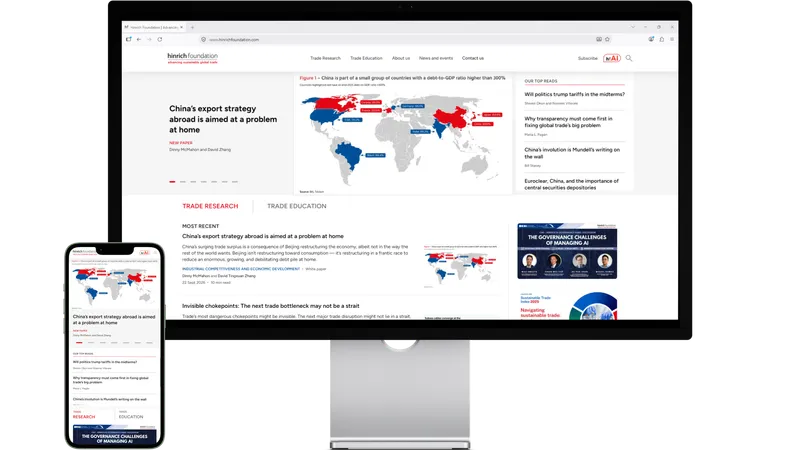
Overview of the Hinrich Foundation Platform
The Hinrich Foundation produces authoritative, data-driven research on sustainable global trade. To maximize the accessibility and usability of their extensive library, Tekcent was engaged as a strategic technology partner to transform their web architecture into an intuitive, high-performance publishing platform and integrate cutting-edge AI capabilities.
Over years of continuous technical collaboration, Tekcent modernized the foundation’s digital web infrastructure and architected an advanced Retrieval-Augmented Generation (RAG) platform across two primary core pillars:
High-Performance Web & Content Infrastructure: Built a scalable, high-speed digital publishing platform optimized for fast page loads, responsive document rendering, and seamless navigation across extensive trade research report archives.
Hybrid External & Internal Knowledge Retrieval Engine: Developed hfAI, a private, enterprise AI platform that ingests complex research PDFs into a vectorized database. By pairing vector search indexing and live external source integrations with Large Language Model (LLM) orchestration, contextual conversation memory, and strict rate-limiting controls, the system enables deep multi-turn semantic queries across both internal publications and external data streams while guaranteeing user privacy and system stability.

Key Technical Deliverables & Architecture
High-Performance Web Publishing Platform: Engineered a scalable, secure web architecture built to handle high global traffic volumes and deliver fast, responsive page loads across extensive research archives, publication libraries, and interactive trade report tools.
Retrieval-Augmented Generation (RAG) Architecture: Designed an enterprise RAG pipeline that grounds AI responses strictly within verified sources, combining internal publication data and connected trade repositories to eliminate hallucinations and output precise, source-backed answers.
Vector Database Indexing & Embedding Pipeline: Implemented automated document ingestion workflows that chunk, process, and index complex multi-page PDF research publications into high-dimensional vector embeddings, enabling ultra-fast semantic search retrieval.
Stateful Conversation Memory & Multi-Turn Context: Built a session management framework that preserves context across chat interactions, allowing users to ask follow-up questions, refine complex queries, and drill down into specific trade research metrics naturally.
External Source & Real-Time API Ingestion: Connected the AI engine directly to trusted third-party databases, live data feeds, and external web APIs, allowing the platform to synthesize current external metrics alongside proprietary foundation reports.
Enterprise LLM Orchestration: Integrated securely with modern Large Language Models via API, managing prompt engineering, multi-source context retrieval, and response synthesis in seconds.
Data Privacy & Governance Boundaries: Architected the system with a strict private data boundary to ensure proprietary research and confidential user queries remain completely isolated, compliant, and protected from public LLM model training.
Rate-Limiting & Operational Controls: Deploys robust API rate limiting, concurrency management, and token throttling mechanisms to safeguard infrastructure against traffic surges, prevent abuse, and guarantee predictable operating costs.
Key Impact & Results
Comprehensive Cross-Source Discovery: Allows analysts, policy makers, and educators to query internal research archives and external trade datasets simultaneously using natural, multi-turn conversational interactions.
Secure, Abuse-Resilient Infrastructure: Delivers enterprise-grade privacy protection alongside robust rate-limited controls, ensuring uninterrupted platform availability and operational stability.
Source-Backed Accuracy: Provides clickable, verifiable citations directly linking to the exact page in internal research PDFs or external source origin points for every generated insight.
Tags